
InfiniteCTRL Operating System (ICOS)
A procedural doctrine for diagnosing constraint and enforcing correct decision sequencing.
ICOS exists to prevent organisations from executing the wrong decisions efficiently.
It diagnoses structural integrity before permission to optimise, scale, digitise, or automate is granted.
It is not a methodology.
It is the operating logic behind every engagement.
Why Most Organisations Scale the Wrong Thing
Most organisations do not fail because they lack effort, talent, or technology. They fail because upstream structural weaknesses are optimised downstream.
THE DOCTRINE
The ICOS Non-Negotiables
ICOS is governed by a small number of structural principles:
Clarity before capability
Structure before optimisation
Commercial logic before automation
Integration before scale
Human judgement as control layer
ICOS does not optimise instabi
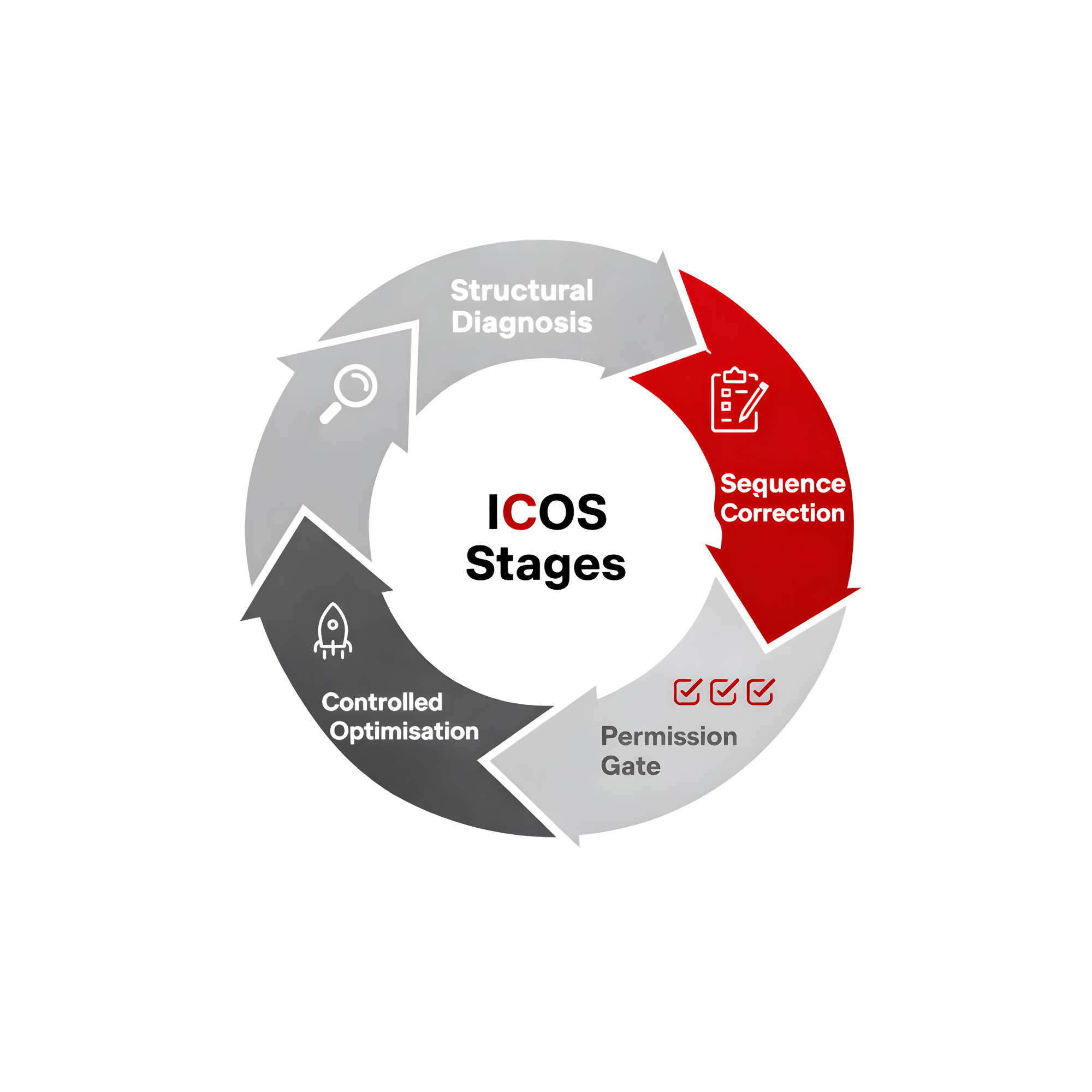
DIAGNOSTIC SPINE
1) Diagnosis
Where is value truly created?
Where is constraint located?
Where does decision latency exist?
Where is cost being manufactured structurally?
Output: Structural map of the Commercial Spine.
3) Permission
No optimisation proceeds without passing three checks:
Structural integrity
Commercial alignment
Human accountability
If those conditions are not met, execution is paused.
2) Correction
What must happen first?
What is currently happening too early?
What dependencies are being ignored?
Output: Correct decision order and intervention sequencing.
4) Optimisation
Only now:
Automation
AI deployment
Energy infrastructure changes
Workflow redesign
Scaling initiatives
…are introduced.
Optimisation becomes leverage — not acceleration of dysfunction.

EXECUTION WITH INTEGRITY
If you are scaling something unstable, ICOS will stop you.
If you are sequencing correctly, ICOS will accelerate you.
That is the difference.
PERMISSION TO OPTIMISE
ICOS enforces a discipline most organisations resist.
• Not every problem deserves execution.
• Not every opportunity deserves scale.
• Not every system deserves automation.
Movement is not progress.
Optimisation without structural integrity accelerates dysfunction.
ICOS creates permission — not momentum.
Only when structural integrity, commercial alignment, and human accountability are verified does optimisation proceed.